
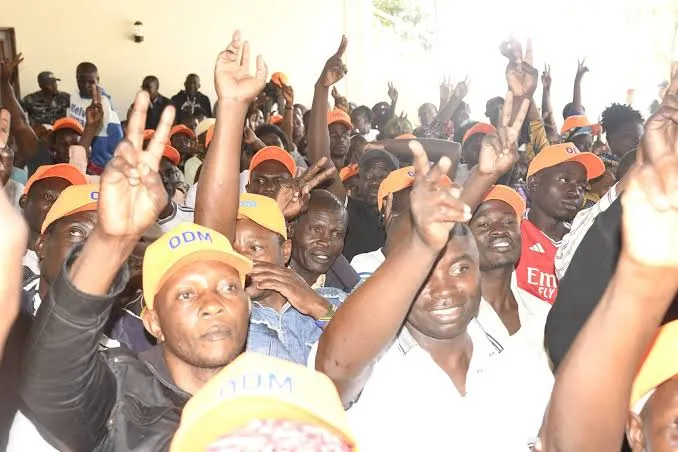
More than 300 Orange Democratic Movement (ODM) delegates from Budalang’i Constituency converged at Governor Dr. Paul Otuoma’s Bunandi residence in a grassroots political engagement that placed party mobilization, voter registration, development, and empowerment at the center of discussions.
Otuoma, who is the ODM Busia Branch Chairman and Governor of Busia County, hosted the delegates as the party seeks to strengthen its grassroots structures and maintain closer engagement with members across the county.
The meeting brought together ODM delegates, members of the County Assembly, and party officials for discussions on the future of the party, civic participation, and development priorities affecting residents.
Otuoma expressed appreciation to the Budalang’i delegates for their continued support for his administration and for him in his capacity as ODM Busia Branch Chairman.
He described their commitment and solidarity as an important pillar in efforts to strengthen the party and advance the interests of Busia residents.
RE-ENERGISING ODM FROM THE GRASSROOTS
A key focus of the meeting was the need to re-energize ODM at the grassroots.
The engagement at Otuoma’s Bunandi residence provided an opportunity for the governor, in his capacity as county ODM chairman, to interact directly with more than 300 delegates from Budalang’i and discuss the party's organization and mobilization strategy.
The discussions touched on strengthening grassroots networks and maintaining closer contact between party leadership, elected representatives, and ordinary members.
The size of the gathering gave the meeting the character of a significant constituency-level political engagement rather than a routine courtesy meeting.
For Otuoma, the gathering also provided an opportunity to listen to grassroots representatives and exchange views on matters affecting the party and the wider county.
ID AND VOTER REGISTRATION
Another major issue on the agenda was mobilization for national identification cards and voter registration.
The emphasis on ID acquisition reflects the importance of ensuring that eligible residents have the documentation required to participate in the electoral process.
Otuoma and the delegates discussed the need for grassroots mobilization to encourage residents without identification documents to obtain them and, where eligible, register as voters.
The issue places civic participation alongside party organization, particularly as political parties begin strengthening their structures ahead of the 2027 General Election.
POLITICAL ALIGNMENT
Political alignment also featured prominently in the discussions.
With national and county politics gradually moving towards the 2027 electoral cycle, political parties and their grassroots networks are increasingly engaging members on alliances, organization, and the political direction of their respective areas.
At Bunandi, Otuoma and the Budalang’i delegates discussed political alignment as one of the issues of mutual interest.
The discussions provided a local platform for delegates to express their views while giving the ODM Busia Branch Chairman an opportunity to engage them on the broader political environment.
The meeting also demonstrated how county-level party leadership can become an important link between grassroots members and wider political developments.
DEVELOPMENT REMAINS CENTRAL
Beyond party politics, the meeting focused on the implementation of development projects and empowerment programs.
This gave the engagement a broader community dimension.
For residents, political discussions are often closely linked to practical questions of development, livelihoods, youth opportunities, women's empowerment, infrastructure, and access to public programs.
The inclusion of development and empowerment on the agenda therefore placed the political conversation within the context of the everyday concerns of Busia residents.
Otuoma's dual position as Busia Governor and ODM Busia Branch Chairman also means that discussions involving party members inevitably intersect with questions about the implementation of his administration's development agenda.
MCA LEADERS JOIN OTUOMA
Otuoma was joined by several members of the County Assembly and other ODM officials.
Those present included Hon. John Omumi of Bunyala Central, Hon. Silvanus Alianda of Bunyala North, and Hon. Stephen Nasiagi of Bunyala Central.
Also in attendance were Hon. Beatrice Kanoti of Bwiri Ward, Hon. Patrick Obongoya, Mwalimu Till Sumba, and Fidelis Opetu, ODM Secretary General, Busia Branch, among others.
Their presence brought together elected county representatives and party officials around the discussions hosted by Otuoma.
The participation of leaders from different wards also gave the meeting a wider county political dimension despite the delegates being drawn primarily from the Budalang'i Constituency.
THE POLITICS OF GRASSROOTS ORGANISATION
The Bunandi meeting illustrates the importance of grassroots organization as parties prepare for the next electoral cycle.
A political party's strength is not measured only by the size of rallies it can convene. It also depends on the durability of its grassroots structures, the strength of its local networks, and its ability to maintain engagement with members between elections.
By hosting more than 300 Budalang’i delegates at his residence, Otuoma created a direct engagement between county party leadership and grassroots representatives.
The agenda—covering party revitalization, ID acquisition, voter registration, political alignment, development, and empowerment—reflected an attempt to connect political organization with practical community concerns.
BUSIA'S POLITICAL LANDSCAPE
The meeting comes as political activity begins to intensify ahead of the 2027 general election.
In Busia, the alignment of county leadership, party structures, elected representatives, and grassroots networks is likely to remain an important feature of political engagement over the coming months.
For Otuoma, the Bunandi meeting provided an opportunity to reinforce his role not only as the county's governor but also as the ODM Busia Branch Chairman.
For the delegates, it was an opportunity to engage directly with their county party chairman and discuss issues ranging from party organization to development.
The immediate challenge will be sustaining the momentum beyond meetings and translating political mobilization into continuous grassroots engagement, increased civic participation, and attention to development priorities.
For now, the message from the gathering at Otuoma's Bunandi residence was clear:
Busia Tuko Tayari!
No comments yet. Be the first to share your thoughts.