
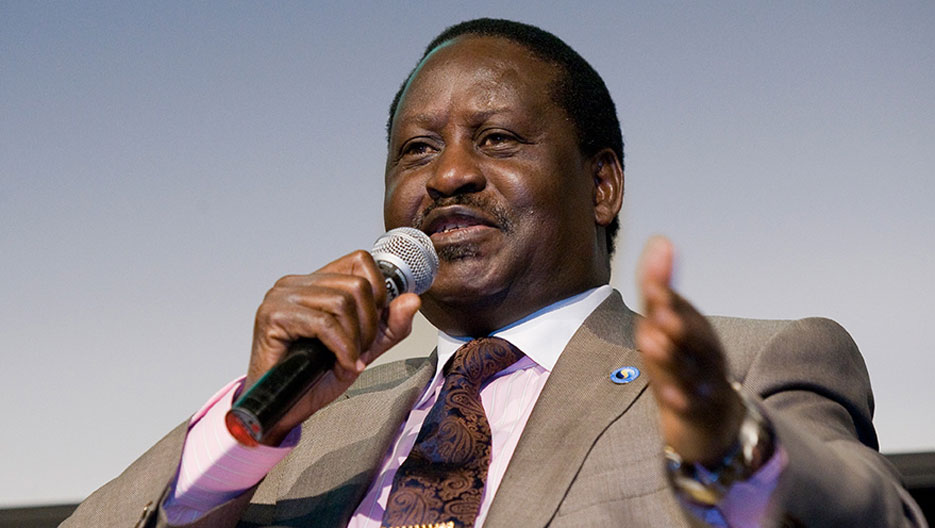
NAIROBI, Kenya—For decades, Kenyan politics has operated on a powerful assumption: that Luo Nyanza votes as one political community, speaks with one voice, and ultimately follows the direction set by its most influential leader.
That assumption survived political repression, electoral defeats, disputed elections, government crackdowns, and the repeated exclusion of opposition constituencies from the center of national power.
Its most formidable custodian was Raila Amolo Odinga, the veteran opposition leader whose political influence extended far beyond his electoral victories. Xavier Lugaga
But what happens when the individual who held together a political community for decades is no longer there to arbitrate its differences, reconcile its rivalries, and direct its collective political choices?
That is the question confronting Luo Nyanza as Kenya enters a new phase of political realignment.
The death of Raila, on October 15, 2025, marked the end of an era in Kenyan politics. His absence has raised questions about the future of the Orange Democratic Movement (ODM), the succession of its leadership and the political direction of a community that often treated his political choices as a collective undertaking.
Yet the deeper question is whether the much-celebrated Luo voting bloc was ever as politically homogeneous as it appeared.
Beneath the image of an electorally disciplined community lie competing ambitions, differences in economic circumstances, geographical rivalries, generational disagreements, and divergent interpretations of what political loyalty should deliver.
Raila's extraordinary influence often concealed these differences. His authority provided a common political reference point around which otherwise competing interests could organize themselves.
Without that authority, the political landscape is likely to become more contested.
The end of a political era does not necessarily mean the end of a political community. It may, however, expose the differences that a dominant leader kept in check.
The myth of the monolithic Luo vote
Kenyan electoral politics has frequently reduced Luo Nyanza to a predictable political constituency whose voting behavior can be understood through the pronouncements of a single leader.
The region's electoral record has, at various moments, reinforced this perception. Raila's presidential campaigns mobilized enormous support across Siaya, Kisumu, Homa Bay, and Migori, transforming regional solidarity into a formidable national political force.
But electoral convergence should not be confused with the absence of internal political differences.
A voter in Bondo may have different economic priorities from one in Rongo. A resident of Kisumu city may assess national politics differently from a farmer in rural Homa Bay or a fishing community along the shores of Lake Victoria.
Land ownership, access to markets, employment, fishing regulations, transport infrastructure, education, county development, and proximity to political power shape voters' decisions in different ways.
There are also differences between established political families and emerging leaders, between older voters whose political consciousness was shaped by the struggles of Jaramogi and younger voters more concerned with jobs, the cost of living, digital opportunities, and the accountability of elected representatives.
These distinctions do not erase a shared Luo identity. Rather, they challenge the proposition that ethnic identity must automatically translate into uniform political behavior.
Raila's leadership provided a mechanism through which these different interests could be accommodated within a broader political project.
His successors must now demonstrate that they can do the same without relying exclusively on his name, historical standing, or personal authority.
The danger for ODM is that its leaders may inherit the structures of a powerful political movement without inheriting the authority that made those structures effective.
Jaramogi versus Tom Mboya: The original fault line
To understand the emerging political contest in Luo Nyanza, one must return to the formative years of Kenya's independence.
The rivalry between Jaramogi Oginga Odinga and Tom Mboya remains one of the most consequential episodes in the history of the country's nationalist movement.
Both men were influential Luo leaders, but they represented different political instincts, constituencies, and visions of Kenya's future.
Jaramogi, Kenya's first vice-president, emerged as a powerful advocate of African liberation, political pluralism, and a more radical approach to the distribution of national wealth. His political base was strongly associated with Siaya and the wider Central Nyanza region.
Mboya, the celebrated trade unionist and independence-era organizer, built a formidable national profile through labor mobilization, international diplomacy, party organization, and engagement with the institutions of the emerging Kenyan state.
His influence was particularly significant among urban workers, trade unionists, and sections of the political elite, including communities and constituencies beyond Luo Nyanza.
Their differences cannot be reduced to a simple contest between interior and lakeside communities. They reflected competing political strategies, ideological orientations, social networks, and approaches to power.
Nevertheless, their rivalry exposed a fundamental reality: even at the height of the independence struggle, Luo political leadership was never the exclusive preserve of one individual or one political tradition.
The community contained different schools of thought about how power should be acquired, exercised, and distributed.
Mboya's assassination in 1969, following years of political tension, deepened the crisis surrounding Luo political representation. The subsequent Kisumu disturbances, triggered by the confrontation involving President Jomo Kenyatta and Jaramogi during the opening of the New Nyanza Provincial General Hospital, further entrenched the region's troubled relationship with the national government.
These events helped shape a political consciousness in which historical grievance, political exclusion, and loyalty to Jaramogi became deeply intertwined.
But history also left a succession problem.
What happens when a community's political identity becomes closely associated with a succession of powerful personalities rather than durable institutions capable of reconciling competing interests?
Jaramogi's son Raila would spend much of his political career answering that question through mobilization, opposition politics, and coalition-building.
Now that Raila is gone, the question has returned with renewed urgency.
Raila: The man who held the center
Raila's political influence cannot be explained solely by ethnicity.
His appeal rested on a combination of personal sacrifice, political endurance, opposition to authoritarianism, populist mobilization, coalition-building, and the ability to convert historical grievances into a national political narrative.
His detention under the Daniel Arap Moi government, his involvement in the struggle for multiparty democracy, and his subsequent presidential campaigns helped establish a political identity that extended beyond his family's historical standing.
For many supporters, Raila represented resistance to exclusion and the possibility of a more equitable distribution of national power.
For others, he was a formidable political strategist who understood how to negotiate alliances, consolidate constituencies, and remain relevant through changing administrations.
He also possessed something difficult to transfer through inheritance: personal authority accumulated over decades.
Raila could reconcile competing ambitions because his political stature gave him the capacity to reward allies, negotiate compromises, and impose strategic discipline when necessary.
He could bring together leaders who disagreed on local issues because the larger political objective was often considered more important than their immediate differences.
He could endorse a national coalition and expect a substantial section of his support base to follow, even when some supporters questioned the political wisdom of the arrangement.
This did not mean that every Luo voter agreed with him or that his political decisions went unchallenged. Nor did it mean that his opponents were necessarily acting against the interests of the community.
Rather, his influence was sufficiently powerful to make his preferred political direction the principal point of reference for much of the region.
His death removed that center of gravity.
The critical test for ODM is whether its institutions can now perform the functions that Raila once performed through a combination of personal authority, political negotiation, and historical legitimacy.
The geography of competing interests
Luo Nyanza is not a single administrative or economic unit. It comprises four counties with distinct political environments, development priorities, and local leadership contests.
Siaya, Kisumu, Homa Bay, and Migori share important cultural and historical connections, but their political interests do not always coincide.
Siaya carries the historical weight of the Odinga political legacy. It is also home to local leaders whose ambitions cannot be indefinitely subordinated to national succession arrangements.
Kisumu combines the politics of a major urban center with the interests of surrounding agricultural communities and lakeside settlements. Employment, infrastructure, public services, business opportunities, and urban governance can shape political choices independently of national ethnic alignments.
Homa Bay has its own networks of political leadership, local rivalries, and development concerns. Its politicians must answer to constituents who may be less interested in the internal organization of ODM than in whether their elected representatives deliver tangible improvements.
Migori presents another political landscape, shaped by its border location, cross-border commerce, fishing, agriculture, mining interests and a diverse population with varied community affiliations.
These differences can create competing priorities over political appointments, development allocations, party positions and the distribution of influence within national coalitions.
A political agreement negotiated by leaders at the national level may not necessarily satisfy supporters at the county or constituency level.
Similarly, a leader's national prominence does not automatically translate into unquestioned authority over local political contests.
The question is not whether these counties will abandon their shared identity. It is whether that identity will continue to dictate their electoral choices when local interests point in different directions.
In a post-Raila environment, county-based political bargaining could become more pronounced.
Regional competition may influence who controls party structures, who receives nominations, who negotiates coalition agreements and whose interests are prioritised when political bargains are struck in Nairobi.
The resulting electoral landscape could become more competitive without necessarily becoming less Luo in its cultural or political identity.
Clan identity and the danger of oversimplification
The internal diversity of Luo society is sometimes discussed through distinctions between communities associated with interior or highland areas and those associated with lakeside or lowland settlements.
Terms such as Luo Kakwaro, Kanyamwa and Kamise may appear in particular local or historical discussions, but their meanings and boundaries should not be treated as universally agreed categories or as definitive explanations of contemporary political behaviour.
Clan identities, settlement histories and local affiliations can matter in particular electoral contests. Yet they interact with class, occupation, education, religion, gender, age and individual political ambition.
It would therefore be misleading to suggest that a single geographical or clan division determines the voting behaviour of Luo Nyanza.
The more important question is how local identities interact with competition for political resources.
Where communities perceive that particular regions or political families have enjoyed disproportionate access to appointments, development projects or party influence, grievances may emerge.
Where such grievances coincide with competitive nominations or succession contests, they can become politically consequential.
A candidate may mobilise support around a perceived imbalance in representation without rejecting the broader cultural identity shared with voters elsewhere in Nyanza.
Equally, a candidate may appeal to voters across clan and county boundaries by promising more accountable leadership and a fairer distribution of resources.
The end of Raila's dominance could create more room for such political calculations.
But fragmentation is not inevitable. It will depend on the conduct of political leaders, the credibility of party institutions and the extent to which voters believe their interests are being represented.
ODM's succession dilemma
The future of ODM is central to the question of whether Luo political unity can survive Raila's absence.
A political party built around a dominant personality faces two related challenges when that personality disappears: preserving its historical identity and establishing a credible mechanism for resolving competition among those who seek to inherit its influence.
These challenges are particularly acute when the founder or dominant leader has served simultaneously as the party's principal mobiliser, coalition negotiator and ultimate political arbiter.
ODM must decide whether its future will be determined by transparent institutional processes or by competing claims to the late leader's political inheritance.
Leadership succession is not merely a question of who occupies the party's highest office. It concerns the distribution of authority across the organisation, the credibility of nominations, the treatment of dissent and the ability of county-level leaders to influence national decisions.
If influential politicians believe that access to the party's leadership is restricted, they may seek alternative platforms or negotiate independent political arrangements.
If grassroots members believe that nominations are predetermined by powerful individuals, party loyalty may weaken.
And if young voters see little connection between historical political sacrifices and present-day economic opportunities, the emotional appeal of inherited political loyalties may diminish.
These pressures are not unique to ODM. They are common to political movements whose organisational strength has been closely tied to an individual leader.
The challenge is particularly significant because ODM's influence has extended well beyond Luo Nyanza. It has depended on alliances with political actors from other parts of Kenya, making the management of national coalitions as important as the consolidation of its regional support.
A divided or uncertain party could find it more difficult to negotiate favourable terms in future alliances.
Conversely, a party that develops credible succession mechanisms and demonstrates internal democracy could preserve much of its influence without requiring the return of a single dominant personality.
The national coalition question
For years, Raila's national political strategy helped determine how Luo Nyanza related to successive governments and opposition formations.
His supporters could be mobilised behind a national coalition even when the interests of individual leaders within that coalition were not perfectly aligned.
His death raises a different question: who can negotiate such agreements with comparable authority, and on what terms?
Future coalition politics may place greater emphasis on the bargaining power of individual leaders, county interests and electoral arithmetic.
Instead of assuming that an endorsement from the centre will automatically secure broad regional support, coalition partners may have to engage more directly with voters and influential leaders across Nyanza.
This could create opportunities for politicians seeking to demonstrate independence from established political structures.
It could also expose divisions among leaders who previously operated under a common political umbrella.
The implications extend beyond Luo Nyanza.
Kenya's political alliances are increasingly shaped by negotiations over executive power, parliamentary representation, development priorities and access to government programmes.
If Luo Nyanza becomes more politically competitive, national parties may find it necessary to negotiate with multiple centres of influence rather than rely on a single regional intermediary.
Such a shift could strengthen bargaining at the county level, although it could also weaken the region's ability to negotiate collectively when its leaders pursue incompatible arrangements.
The decisive factor will be whether political competition produces stronger representation or merely a contest among elites for access to power.
The generational challenge
Perhaps the most significant threat to the assumption of an automatic Luo voting bloc comes not from clan rivalry or county competition, but from generational change.
Younger voters did not all experience the political struggles that shaped Raila's rise. Their understanding of national politics is increasingly influenced by unemployment, the cost of living, taxation, education, digital communication and the performance of elected officials.
For these voters, historical loyalty may remain meaningful, but it is unlikely to be sufficient on its own.
They may ask why a community that has repeatedly demonstrated electoral solidarity should continue to do so if the expected benefits are not visible in public services, employment opportunities and economic development.
They may question leaders who invoke historical grievances but offer limited answers to contemporary problems.
They may also reject the notion that political loyalty requires unquestioning support for a particular party or family.
This does not mean younger voters will abandon ODM or turn away from Luo political identity. It means that political allegiance may become more conditional, issue-driven and open to competition.
A candidate who offers credible proposals on jobs, agricultural productivity, fishing livelihoods, small businesses and accountable county government could attract support across established political boundaries.
Equally, an established leader who demonstrates competence and responsiveness could retain support without relying exclusively on ethnic mobilisation.
The future of Luo Nyanza may therefore depend less on finding another Raila and more on whether its political leadership can respond to the changing expectations of its electorate.
Will the Luo vote fragment in 2027?
The 2027 General Election will provide an important test of how Luo Nyanza adapts to the loss of its dominant political figure.
However, the absence of Raila does not automatically mean that his supporters will abandon ODM, vote for rival parties or divide along county and clan lines.
Political loyalties are shaped by party structures, candidates, national alliances, local interests and the choices available to voters.
A credible successor could preserve substantial electoral cohesion by demonstrating an ability to unite competing interests and negotiate effectively with other political formations.
Alternatively, multiple candidates claiming Raila's political inheritance could create space for greater competition within the region.
The outcome may vary from one county to another and from parliamentary contests to gubernatorial and ward-level elections.
In some areas, established party loyalties may remain strong. In others, local rivalries and the search for alternative leadership may become more influential.
Cross-ethnic coalitions could also become more attractive where candidates believe they can build broader electoral support by appealing to voters on the basis of development, governance or national political interests.
These possibilities should not be mistaken for certainties. Without credible polling, candidate-level evidence and a detailed assessment of local political dynamics, claims about the inevitable collapse of the Luo vote would be premature.
The more defensible conclusion is that Raila's absence has made the maintenance of political unity a question of leadership, institutions and performance rather than an automatic consequence of personal allegiance.
The danger of confusing loyalty with accountability
One of the enduring contradictions of ethnic bloc politics is that electoral solidarity can strengthen a community's bargaining power while simultaneously weakening its ability to hold individual leaders accountable.
When voters are repeatedly told that political unity is essential for protecting communal interests, criticism of elected representatives can be portrayed as disloyalty.
This can discourage scrutiny of public expenditure, development failures, broken campaign promises and the conduct of local political elites.
Yet a community's political strength should not be measured solely by the consistency with which it votes for one party.
It should also be measured by the quality of representation it receives, the accountability of its leaders and its ability to replace those who fail to perform.
If Raila's absence creates room for more competitive elections in Luo Nyanza, that competition need not be interpreted as a political tragedy.
It could provide voters with more choices, encourage candidates to articulate clearer development agendas and compel party leaders to take grassroots concerns more seriously.
The danger arises when fragmentation becomes a struggle among political patrons rather than a contest over public policy.
Replacing one dominant personality with several competing political families would not necessarily improve democracy.
The real test is whether the region can move from personal political dependence towards institutions that allow disagreement without destroying solidarity.
Beyond the politics of inheritance
Raila Odinga's political legacy will remain a powerful force in Kenya long after his death. His contribution to multiparty democracy, opposition politics and national coalition-building cannot be separated from the country's modern political history.
But legacy is not the same as a transferable mandate.
No individual can simply inherit the accumulated authority, political experience and personal relationships of a leader who spent decades building them.
Those seeking to lead Luo Nyanza must earn their own legitimacy.
That requires more than invoking Raila's name, displaying photographs of the late leader or presenting oneself as the custodian of his political memory.
It requires credible leadership, transparent party processes, responsiveness to grassroots concerns and a practical programme for improving people's lives.
It also requires accepting that Luo voters, like voters elsewhere in Kenya, are entitled to disagree with one another.
Siaya need not always share Kisumu's political priorities. Homa Bay need not subordinate every local contest to decisions made elsewhere. Migori voters need not interpret political loyalty in exactly the same way as voters in other counties.
Such differences do not make a community less cohesive. They become divisive when leaders exploit them for personal advantage or deny others a fair share of political representation.
The post-Raila era therefore presents both a risk and an opportunity.
It could expose unresolved rivalries and weaken the region's collective bargaining power. Alternatively, it could produce a more pluralistic political culture in which unity is built through negotiation, shared interests and accountable leadership rather than personal authority alone.
The final verdict: A bloc must be earned
The idea of a permanently unified Luo voting bloc was always an oversimplification of a more complex political reality.
Raila Odinga's exceptional influence made that unity appear more automatic than it was. His absence has exposed the challenge of sustaining a common political direction without the individual who so often determined it.
The decisive question is no longer simply who will succeed Raila.
It is whether the region's leaders can build a political arrangement that accommodates internal differences, protects grassroots participation and advances shared economic interests without demanding uniformity at the ballot box.
If they fail, Luo Nyanza could experience more competitive county politics, fragmented party loyalties and increasingly individualised electoral bargaining.
If they succeed, the region could preserve its collective influence while giving voters greater freedom to choose leaders on merit and performance.
Either way, the old assumption that a single endorsement can settle every political contest deserves closer scrutiny.
The twilight of the patron is not necessarily the twilight of Luo political influence. It is the end of the assumption that such influence must depend on one man.
Raila Odinga may have been the most powerful unifying figure of his generation, but no community should have to depend indefinitely on a single political personality to define its future.
The real measure of his legacy will not be whether Luo Nyanza can find another Raila.
It will be whether the community can build institutions strong enough to survive without one.
No comments yet. Be the first to share your thoughts.