
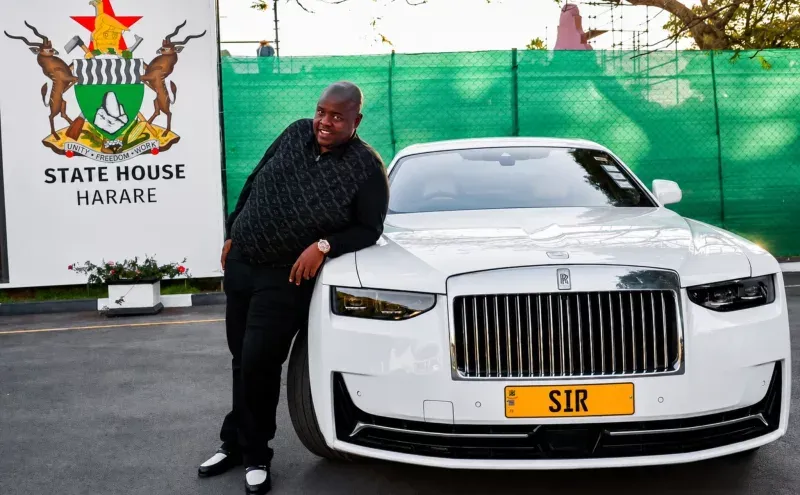
There are journeys that end at their destination.
And there are journeys that end a life.
For Wicknell Chivayo, the final journey began in the sky.

The destination was supposed to be another stop in the life of a man accustomed to moving between luxury, business, political circles and presidential compounds.
Instead, the helicopter came down in rural Marondera, Zimbabwe, at about 5 p.m. on Wednesday, September 30, 2026.
There were no survivors, according to Zimbabwean authorities.
Chivayo was reportedly among the dead, alongside his wife, Lucy "Lulu" Muteke. Family sources have since confirmed his death, while early official accounts differed over the exact number of people aboard the aircraft.
And suddenly, the man who seemed to live a life of movement was still.
The helicopters.
The luxury cars.
The private jets.

The presidential photographs.
The extravagant gifts.
The business deals.
The social-media spectacle.
The extraordinary access.
All of it had been part of the Chivayo story.
But perhaps nowhere was that story more intriguing to Kenyans than in his relationship with President William Ruto.
The big kiss for Ruto
If politics is partly about proximity, Chivayo appeared to have mastered the art of proximity.
He was not Kenyan.
He did not hold public office in Kenya.
Yet he repeatedly appeared in the orbit of the Kenyan President.

State House.
Presidential residences.
Official and private occasions.
Family functions.
And then came a moment that captured the imagination of the public.
In August 2026, after attending the traditional engagement ceremony of Ruto's daughter, Charlene Ruto, at the family's Intonna Heritage Farm in Kilgoris, Narok County, Chivayo was preparing to leave for his waiting helicopter.
Then something extraordinary happened.
President Ruto took the wheel.
The Head of State personally drove Chivayo and his wife approximately three kilometres towards the helipad.
Chivayo recorded the moment.
His excitement was unmistakable.
"I am being driven by the President of Kenya," he exclaimed in the video.
Ruto laughed.
For Chivayo, the short drive was not merely a ride.
It was a symbol.
A moment of access.
A moment of personal warmth.
A moment that said more about the relationship than a formal State House photograph ever could.
The episode was reported by Kenyan media, including The Standard and The Star.
Chivayo himself went even further.
He publicly thanked Ruto for what he described as genuine love, kindness and affection, saying the President had treated him "as your own child."
That is the big kiss for Ruto in the Chivayo story—not a literal kiss, but a remarkable public display of personal warmth, trust and access between a sitting African President and a foreign businessman.
And it was captured on camera.
From State House to Kilgoris
The helicopter ride to Marondera was not the first time Chivayo had occupied the Kenyan political spotlight.
His encounters with Ruto stretched back well before the dramatic Kilgoris episode.
In January 2025, Chivayo publicly documented a visit to State House in Nairobi, describing it as a courtesy call during which renewable-energy issues were discussed.
He subsequently appeared with Ruto at other locations and occasions.
By 2026, the encounters had become frequent enough to attract sustained public attention.
Chivayo documented meetings at State House, Sagana and Wajir, among other places. The Star reported that his repeated access to Ruto had prompted questions about how a Zimbabwean businessman had developed such an unusually visible relationship with the Kenyan presidency.
Chivayo, however, presented the relationship in affectionate and admiring terms.
In his own public posts, he praised Ruto's leadership, humility and faith.
He portrayed the President not merely as a political leader but as someone from whom he received wisdom and guidance.
The language was striking.
The access was even more striking.
The photograph that became a political story
There is nothing unusual about businessmen meeting presidents.
Africa's presidents routinely meet investors, entrepreneurs and corporate leaders.
But Chivayo's case became different because he did not merely meet Ruto.
He repeatedly showed the encounters to the public.
He showed the State House meetings.
He showed presidential surroundings.
He showed himself alongside Ruto.
And eventually he showed Ruto behind the steering wheel.
That changed the visual language of the relationship.
The public was no longer simply being told that a businessman had access to a president.
The public could see it.
And images can sometimes become more powerful than explanations.
The business question
Then came the business dimension.
Chivayo's interests increasingly intersected with Kenya's economic landscape.
His name became associated with discussions surrounding major infrastructure and energy opportunities, including reports concerning the proposed expansion and modernisation of Jomo Kenyatta International Airport.
The reported value of the proposed JKIA project ran into hundreds of billions of shillings.
But this is where the story requires a journalist's red line.
A meeting with President Ruto is a documented event.
A business association is a matter that can be established through corporate and procurement records.
An allegation that political access produced an improper business advantage is something entirely different.
It requires evidence.
Chivayo denied using political relationships to obtain favours.
Therefore, the existence of the relationship should not automatically be presented as proof of improper conduct.
The questions surrounding business dealings belong to documents, procurement records, contracts, audits and investigations—not speculation.
The man behind the spectacle
Chivayo was never simply a businessman.
He became a phenomenon.
His social-media presence transformed wealth into theatre.
Luxury vehicles.
Private aircraft.
Designer clothing.
Expensive watches.
Lavish homes.
Millions in gifts.
High-profile friendships.
Presidential encounters.
His supporters saw generosity.
His critics questioned the origins of his wealth and his government-linked business history.
Both narratives became part of his public identity.
And through it all, Chivayo appeared determined to show the world that he had arrived.
He did not hide his wealth.
He displayed it.
He did not hide his political access.
He displayed that too.
Then the sky went silent
And then came September 30.
Marondera.
Approximately 5 p.m.
A helicopter.
A crash.
A fireball—or wreckage, depending on the final investigation's findings.
And silence.
Zimbabwean authorities confirmed that an aircraft had crashed and that there were no survivors. Initial reports differed over the number of people aboard, while later reports identified Chivayo and his wife among the victims.
The cause remains a matter for investigators.
That distinction matters.
There is currently no established evidence that the crash was connected to Chivayo's business dealings, political relationships or public profile.
The aircraft must speak through its wreckage.
The flight records must speak.
The maintenance history must speak.
The weather must speak.
The pilot's qualifications and communications must speak.
Only then can the final story of the crash be responsibly written.
But Kenya will remember the photographs
Zimbabwe will remember Wicknell Chivayo as a flamboyant businessman whose life was filled with controversy, wealth and extraordinary public visibility.
Kenya will remember another side of him.
The foreign businessman who somehow became a familiar figure around William Ruto.
The man who sat at State House.
The man who appeared at presidential functions.
The man who attended a major family ceremony at the President's private residence.
The man who filmed the President personally driving him to his helicopter.
That final image may now carry a different emotional weight.
Chivayo was sitting in the passenger seat.
His wife was behind him.
Ruto was driving.
The destination was the helicopter.
The journey was only about three kilometres.
Nobody in that vehicle could have known that, weeks later, Chivayo's name would be associated with another helicopter—and a journey from which he would never return.
The final irony
For a man whose life was defined by movement, the final image is haunting.
He travelled through Africa's corridors of wealth and power.
He moved between Harare and Nairobi.
Between business meetings and presidential compounds.
Between luxury vehicles and helicopters.
Between public controversy and spectacular generosity.
He appeared to have mastered the geography of influence.
But the sky has no political party.
No business partner.
No presidential connection.
No social-media audience.
When the helicopter went down in Marondera, all those distinctions disappeared.
There were no businessmen.
No presidents.
No VIPs.
No celebrities.
Only human beings.
And death.
What remains
Chivayo's death, if formally consolidated through the full investigative record, leaves behind more than a business empire and a social-media archive.
It leaves questions.
Questions about his extraordinary rise.
Questions about his business dealings.
Questions about the networks he built.
Questions about his relationships with African political leaders.
And, inevitably, questions about the remarkable relationship he publicly cultivated with William Ruto.
But those questions should not be confused with conclusions.
The evidence must determine the answers.
For now, one image remains particularly powerful.
A Zimbabwean tycoon sits in the passenger seat.
The President of Kenya is behind the wheel.
They are laughing.
They are travelling towards a helicopter.
It is an apparently ordinary three-kilometre drive that, at the time, looked like another chapter in Chivayo's extraordinary life.
Tonight, after the news from Marondera, it looks different.
Much different.
Because sometimes history changes the meaning of an image after the camera has stopped recording.
And sometimes the final journey begins long before anyone knows it is the final journey.
No comments yet. Be the first to share your thoughts.