

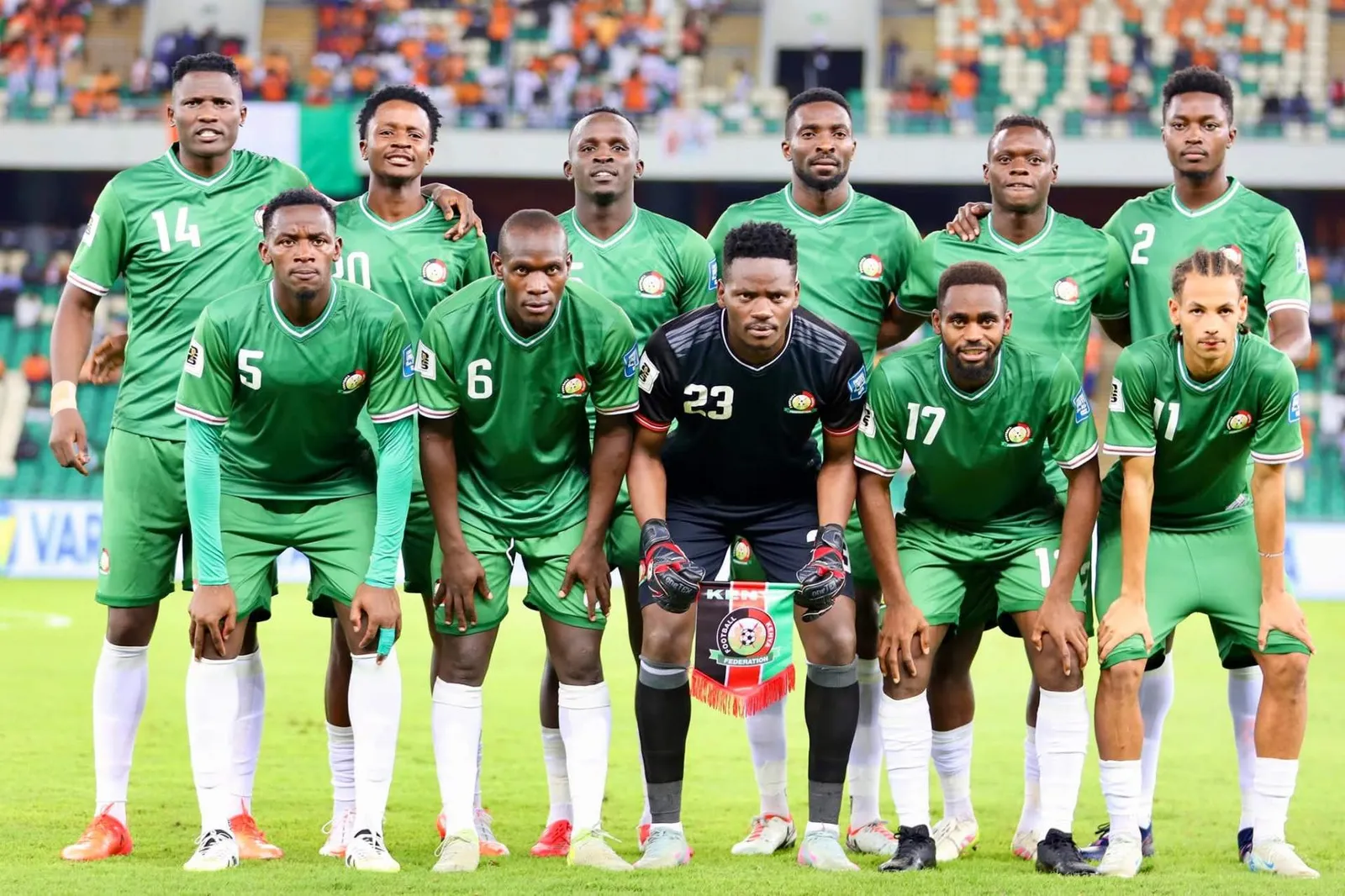
By xavier Lugaga

There is a dangerous habit in Kenyan football: we wait for the match to expose our weaknesses before we begin asking the difficult questions.
Harambee Stars cannot afford that luxury anymore.
After two opening matches in the 2027 Africa Cup of Nations qualifying campaign, Kenya have collected only one point — a 1–1 draw with Eritrea in Nairobi followed by a 1–0 defeat to Guinea in Conakry.
The results are disappointing, but the performances tell a more complicated story.

Against Eritrea, Kenya dominated significant periods but struggled to convert possession and opportunities into goals. Ryan Ogam eventually rescued a point with an 87th-minute equaliser.
In Conakry, however, Harambee Stars showed greater resistance against a stronger opponent. Yet resistance alone could not rescue them. Serhou Guirassy's 32nd-minute goal proved decisive, with Kenya struggling to generate enough attacking danger to find an equaliser.
And that is where the difficult questions begin.
Kenya must learn to play beyond possession
There were moments when Harambee Stars appeared capable of finding their rhythm.
The players competed.
They moved the ball.
They showed determination.

But international football demands something beyond effort and possession.
It demands penetration.
When Guinea's defensive structure became difficult to break, Kenya appeared short of attacking solutions. The ball could be circulated, but getting into dangerous areas with purpose became increasingly difficult.
That is not merely a question of fitness.

It is a question of tactical preparation.
A team must know what to do when the obvious route is blocked.
If the centre is congested, attack the spaces on the wings.
If the wings are closed, create overloads through midfield.

If the opposition sits deep, move defenders rather than repeatedly delivering predictable balls into crowded areas.
If the striker is isolated, midfielders must arrive around him.
If the first attacking move fails, the second phase must already have a purpose.
These movements cannot be invented in the final minutes of an international qualifier.
They must be rehearsed ab initio — from the beginning.
The training ground is where solutions are created
The technical bench should be asking uncomfortable but necessary questions.
How does Kenya break a compact defensive block?
Who makes the penetrating run?
Who creates space for that runner?
Who attacks the second ball?
Who provides the final pass?
Who arrives late into the penalty area?
And when Plan A fails, what is Plan B?
Those questions should be answered long before the team walks onto the pitch.
International football is unforgiving because opponents study each other. They identify strengths, close spaces and force teams to find alternatives.
Kenya therefore needs tactical repetition.
Players must become familiar with combinations until movement becomes almost instinctive.
A midfielder receiving the ball should already have an idea where his winger, striker or overlapping full-back is likely to be.
That is how hesitation disappears.
That is how possession becomes penetration.
And that is how promising attacks become goals.
Kenya must stop confusing effort with effectiveness
Nobody can fault a player simply because a shot does not go in. Football contains uncertainty, pressure and moments of individual brilliance.
But effort alone cannot be the measure of performance.
Running without creating meaningful chances is not enough.
Possession without penetration is not enough.
Crossing without adequate targets in the box is not enough.
Reaching the opposition penalty area without seriously threatening the goalkeeper is not enough.
Harambee Stars need greater efficiency in the final third.
The Eritrea match already exposed the finishing problem. Kenya created opportunities but could not convert enough of them, while against Guinea the attacking threat was even more limited. Contemporary match assessments similarly noted that Kenya rarely threatened the Guinean goal.
This is where technical work must become more intense.
Finishing should not simply mean shooting at the end of training.
It should involve decision-making under pressure, movement inside the box, one-touch combinations, cut-backs, second balls, transitions and creating shooting opportunities against organised defensive units.
The coach must be given the questions — and must provide the answers
Benni McCarthy inherited a team that requires development rather than cosmetic adjustments.
The opening two matches provide material for serious technical analysis.
Why did Kenya struggle against Eritrea despite long periods of possession?
Why did the team concede the initiative at critical moments?
Why did attacking combinations become predictable?
Why did the team struggle to create enough danger against Guinea?
And perhaps most importantly: what tactical changes can be introduced before the next international window?
These are not questions about personalities.
They are football questions.
The answer should therefore be found through video analysis, training-ground repetition, player combinations and tactical planning.
The positive side must not be ignored
There is also a danger in looking only at the results.
Kenya's place at the 2027 AFCON finals is already secured because the country is one of the three co-hosts alongside Uganda and Tanzania. CAF has nevertheless structured these qualifiers as competitive matches, giving McCarthy an opportunity to build and assess his squad ahead of the tournament.
That makes the current campaign important for another reason.
It is preparation under competitive pressure.
Kenya should therefore use these matches as a laboratory for building a side capable of competing at home when AFCON arrives.
The objective should not merely be to survive qualifying fixtures.
It should be to develop a recognisable football identity.
The next stage must be about tactical growth
The next challenge is South Africa.
That will provide another examination of Kenya's ability to compete against a high-level opponent. The match is scheduled for November 11.
Between now and then, the technical team has time to work.
The focus should include:
attacking transitions;
breaking compact defensive blocks;
combination play around the penalty area;
movement without the ball;
finishing under pressure;
midfield support for the striker;
set-piece efficiency;
defensive organisation;
and decision-making in the final third.
Above all, Kenya must develop alternative ways of attacking.
A national team cannot depend on one player, one formation or one attacking idea.
When one door closes, another must open.
Harambee Stars need preparation, not miracles
Kenya has football talent.
What has been missing too often is the conversion of that talent into a coherent, repeatable and dangerous team performance.
The Guinea defeat should therefore not simply be filed away as another disappointing result.
It should be studied.
Every misplaced pass should tell a story.
Every failed attacking movement should become a training exercise.
Every missed opportunity should become a lesson.
Every tactical weakness should be identified before the next opponent exploits it.
That is what ab initio means in football terms: recognising the problem before it becomes a crisis.
Harambee Stars do not need miracles.
They need preparation.
They need tactical discipline.
They need attacking imagination.
They need sharper decision-making.
They need confidence in the final third.
And they need a technical culture in which weaknesses are identified, analysed and corrected before the next match.
Because football eventually exposes everything.
If Kenya cannot turn possession into penetration, penetration into chances, and chances into goals, the scoreboard will continue telling the same story.
The time to build Harambee Stars is not after another disappointing result. It is now — ab initio.
Start writing your story…
No comments yet. Be the first to share your thoughts.