
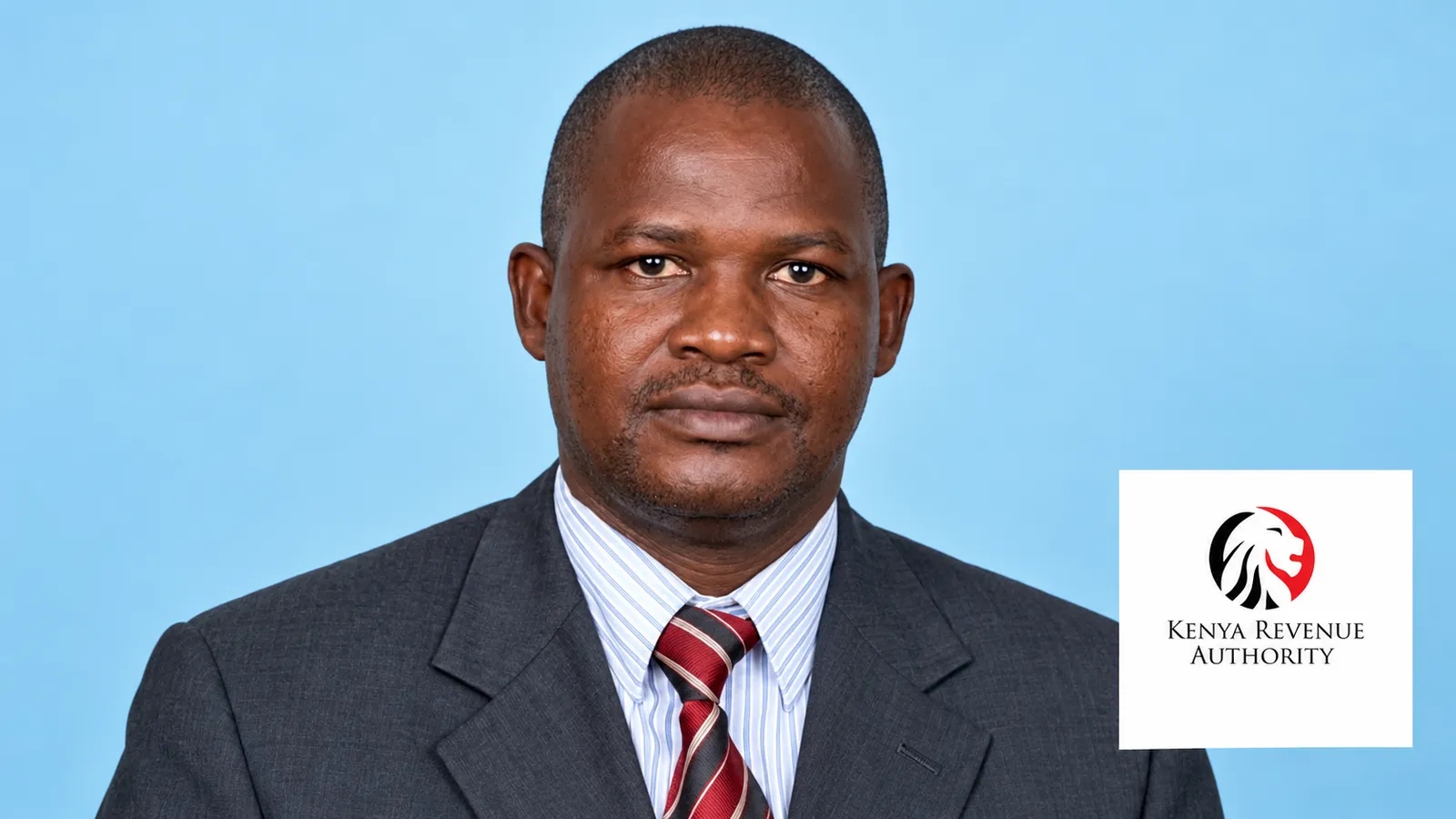
At 35, Jared Ratemo Mokua was a lawyer, a family man, and a career public servant working at the heart of Kenya’s international trade system. His professional responsibilities placed him at a critical junction where shipping manifests, customs declarations, cargo movements, and government revenue converged.
Attached to the Kenya Revenue Authority’s (KRA) Customs and Border Control Department, Ratemo was stationed at Consolbase Container Freight Services (CFS) in Mombasa, where imported cargo passed through a complex chain of documentation, inspection, clearance, and release.
His position gave him exposure to the intricate processes governing the movement of goods through Kenya’s maritime gateway. It was also a position in which discrepancies between physical cargo movements and electronic customs records could raise serious questions about compliance, accountability, and the protection of public revenue.

But behind the professional title was a man whose life had begun far from the bustle of Mombasa’s port facilities.
Ratemo’s story, as presented in accounts of his life and alleged discovery of irregularities in cargo documentation, raises troubling questions about the risks that can confront public officers working in sensitive revenue-collection environments.
Was his death connected to what he may have discovered at the port? Or did the circumstances surrounding his killing have another explanation?
Those questions demand evidence, independent investigation, and careful examination of the available records. The suggestion that he was murdered to silence him remains an allegation unless established by credible investigative findings or a court of law.
FROM EGETUKI VILLAGE TO THE GATES OF POWER
Ratemo was born and raised in Egetuki Village, Ogembo, in Kisii County, into a large family headed by his parents, Elizaphan Mokua and Miriam Gesare.
He grew up alongside several siblings, including Henry Kissinger Mokua, Harun Mokua, Alice, Rachael, Hyline, Nancy, Delphine, James, and Jeliah. The family had also suffered the loss of two daughters, Carren and Zipporah.
His upbringing in a large family formed part of the personal history of a man who would eventually establish himself in the legal and public-service professions.

Education became a defining feature of his journey.
He attended Alliance High School, one of Kenya’s prominent national secondary schools, where he completed his Kenya Certificate of Secondary Education (KCSE).
For many young Kenyans, admission to such an institution represents an important educational milestone. For Ratemo, it was a stepping stone towards university education and a professional career.
In 2001, he joined the University of Nairobi to pursue a Bachelor of Laws (LLB) degree.
At university, he was reportedly active beyond the lecture halls, participating in student-union activities, competitive football, and religious fellowships. These activities placed him within the wider social and intellectual environment of university life, where academic training often intersects with leadership, public debate, and personal ambition.
His legal education would later complement his work in public service, particularly in an institution responsible for administering customs laws, enforcing revenue regulations, and facilitating legitimate international trade.
JOINING KRA: A CAREER AT THE CENTRE OF INTERNATIONAL TRADE
Ratemo joined the Kenya Revenue Authority in January 2010.

His career developed within an institution whose responsibilities extend beyond collecting taxes. At the port of Mombasa, customs officers also play a critical role in regulating imports, verifying declarations, facilitating lawful transit trade, and protecting the country against revenue leakages.
Over the following years, Ratemo rose through the ranks to become a supervisor in the Customs and Border Control Department.
His posting to Consolbase Container Freight Services placed him within a busy cargo-handling environment linked to the movement of goods through Mombasa, Kenya’s principal seaport.
Container freight stations operate within a network involving shipping lines, clearing and forwarding agents, transporters, customs officials, importers, and exporters. Each consignment must be supported by documentation that identifies the goods, their destination, applicable duties, and the conditions under which they may be released or transferred.
Where cargo is destined for another country, the documentation must also support the legitimacy of its movement through the transit system.
The accuracy of those records is essential.
A container declared for transit to Uganda, for example, cannot simply be treated as an ordinary domestic import without the appropriate legal and customs procedures. Its movement must be accounted for through the relevant clearance and transit controls.
The same principle applies to goods destined for Rwanda, South Sudan, and other regional markets.
If physical cargo movements do not correspond with the electronic records, investigators may need to establish whether the discrepancies resulted from administrative errors, delayed updates, procedural failures, fraud, or deliberate interference with customs controls.
Such distinctions are critical because a discrepancy is a warning sign, not proof of criminal wrongdoing.
THE ALLEGED DISCOVERY: WHEN CARGO MOVEMENTS AND DIGITAL RECORDS DID NOT MATCH
According to the account provided about Ratemo’s work, a significant development allegedly occurred between October and December 2016, when he was serving as a supervisor at Consolbase Container Freight Station in Mombasa.
During that period, he reportedly undertook a systematic comparison of physical cargo manifests and arrivals against electronic entries in KRA’s Simba customs clearance system.
The Simba system is associated with customs processing and the electronic management of import and export transactions. Such systems are intended to improve traceability, facilitate legitimate trade, and support the enforcement of customs requirements.
The account alleges that Ratemo encountered recurring discrepancies involving high-value consignments, including sugar, ethanol, and motor vehicles.
According to the allegation, some containers were physically leaving the depot at night while their electronic records continued to describe them as being in transit to Uganda or as being held pending payment of duties.
If independently verified, such discrepancies would warrant a thorough examination of the cargo records, release authorizations, transit documentation, and applicable revenue assessments.
The central question would be whether the physical movement of each container was lawful and properly documented.
Investigators would need to establish the identity of the consignments, the dates and times of their departure, the officials who authorized their release, the transporters involved, and the destinations recorded in the customs system.
They would also need to determine whether the electronic entries were accurate at the relevant times, whether subsequent updates were made, and whether any discrepancies resulted in unpaid duties or other losses to the public purse.
Without the underlying manifests, Simba transaction histories, gate registers, and corroborating testimony, it would be premature to conclude that the alleged discrepancies established a deliberate scheme to divert cargo.
Nor can the allegations, on their own, establish who may have been responsible.
WHY TRANSIT CARGO IS A SENSITIVE CUSTOMS BUSINESS
The allegations touch on a particularly sensitive area of international trade: the movement of goods through one country to another destination.
Kenya serves as an important gateway for landlocked countries in East and Central Africa. Cargo arriving through Mombasa may be destined for domestic consumption or for transit to regional markets.
Transit arrangements are designed to facilitate trade without automatically treating every consignment passing through Kenya as goods intended for the Kenyan market.
That arrangement depends on controls that establish where the cargo is going, the conditions under which it is moving, and whether it reaches its authorized destination.
Where a consignment is permitted to move under a customs transit procedure, its records must be reconciled with the applicable documentation and controls. The precise requirements depend on the transaction and the relevant customs regime.
A discrepancy between the physical location of cargo and its electronic status may therefore raise several possibilities.
Was the cargo lawfully released but the electronic record not updated promptly? Was the consignment transferred under an authorized procedure? Were the goods diverted from their declared destination? Were the applicable duties paid, secured, or otherwise accounted for?
Or did someone deliberately manipulate the documentation to conceal an unlawful release?
Those are materially different possibilities. Each requires documentary evidence and an investigation capable of distinguishing administrative failures from criminal conduct.
If the alleged pattern involving sugar, ethanol, and motor vehicles existed as described, investigators would also need to establish whether the consignments were connected by a common method, common beneficiaries, or common authorizing officials.
A series of similar discrepancies can justify closer scrutiny, but similarity alone does not prove a coordinated criminal enterprise.
THE QUESTIONS THAT THE RECORDS WOULD NEED TO ANSWER
The most consequential aspect of the account is not merely the suggestion that containers left a depot at night. It is the alleged mismatch between physical cargo movements and their recorded customs status.
To establish what happened, investigators would need to reconstruct the movement of each disputed consignment.
The first line of inquiry would be the cargo documentation: the bills of lading, customs declarations, manifests, transit entries, and release instructions associated with the containers.
The second would concern the electronic audit trail. Who created the relevant Simba entries? Who changed them? When were the changes made? Were the records subsequently amended, and, if so, by whom and for what stated reason?
The third would be the physical movement of the goods. Gate registers, security logs, vehicle records, weighbridge documentation and available surveillance footage could help establish whether the containers left the facility, when they departed and which vehicles transported them.
The fourth would concern the financial trail. Were duties paid or secured where required? Were exemptions or transit procedures lawfully applied? If revenue was lost, how much was involved, and who benefited from the transactions?
Finally, investigators would need to establish what Ratemo personally knew.
Did he prepare a formal audit report? Did he submit a written complaint or alert his superiors? Did he identify particular consignments, officials or companies? Were his findings acknowledged, investigated or disputed?
These questions cannot be answered by speculation. They require original records, corroborated testimony and a clear chronology of events.
THE MURDER QUESTION: A THEORY THAT REQUIRES PROOF
The headline question—whether Ratemo was murdered to silence him—goes to the heart of the allegations, but it must be approached with particular care.
A person’s professional responsibilities, even when they involve sensitive financial or regulatory matters, do not establish a motive for murder.
To determine whether his death was connected to his work, investigators would need to establish the circumstances of the killing, identify any threats or conflicts that preceded it and examine whether there was a demonstrable link between those events and his professional activities.
That would require a documented timeline covering his alleged discovery of irregularities, any subsequent reporting or confrontation, communications with colleagues and superiors, and the events immediately preceding his death.
Investigators would also need to consider alternative explanations rather than assuming that the alleged customs discrepancies necessarily explain the killing.
If there were credible evidence that Ratemo had been threatened because of his work, that evidence would be significant. If communications, witness statements or other records connected individuals involved in disputed cargo transactions to the circumstances of his death, those leads would warrant investigation.
But the existence of a possible motive is not proof of responsibility. Neither is the coincidence of a person's professional activities and subsequent death.
The question must ultimately be resolved through evidence capable of withstanding independent scrutiny and, where criminal charges are brought, the requirements of a fair trial.
A FAMILY LEFT WITH QUESTIONS
For the family of Elizaphan Mokua and Miriam Gesare, Ratemo was more than a lawyer or a KRA supervisor.
He was a son and brother whose journey had taken him from Egetuki Village to Alliance High School, the University of Nairobi and a career in public service.
The loss of a family member under circumstances that remain unclear can leave relatives struggling to reconcile the person they knew with the unanswered questions surrounding his death.
If the allegations concerning his customs work remain unresolved, the family and the public have legitimate reasons to seek clarity through lawful investigative channels.
That search for answers should not depend on rumours, unverified accusations or the premature identification of suspects. It should depend on a credible account of what happened, supported by evidence and made available through appropriate legal processes.
THE PUBLIC INTEREST: PROTECTING REVENUE AND ACCOUNTABILITY
The allegations also raise a wider institutional question about the safeguards that govern customs operations.
Kenya's revenue collection system depends on accurate declarations, reliable cargo tracking, effective supervision and the ability to investigate irregularities without fear or favour.
Where an employee identifies a possible breach of procedure, an effective internal control system should provide a clear process for documenting the concern, preserving relevant records and referring credible evidence to the appropriate investigative authorities.
Equally important is the protection of the integrity of the investigation. Electronic audit trails should be preserved, relevant documents secured and witnesses interviewed in a manner that allows their accounts to be independently tested.
If wrongdoing is established, responsibility should be determined on the basis of individual evidence and applicable law.
If the discrepancies prove to have resulted from administrative failures rather than criminal conduct, the findings should reflect that conclusion.
The objective must be the truth, not a predetermined narrative.
THE QUESTIONS THAT REMAIN
Ratemo's story, as presented in the account of his career and the alleged customs discrepancies, leaves several questions requiring documentary clarification:
Were the reported discrepancies involving sugar, ethanol and motor vehicles formally documented?
Did Ratemo prepare an audit report or submit a complaint to KRA management?
Were the disputed containers lawfully released, and were their destinations verified?
Did an investigation establish whether the alleged discrepancies caused revenue losses?
Were any threats against Ratemo documented before his death?
Have investigators established any connection, supported by evidence, between his professional activities and the circumstances of his death?
These questions should be answered through reliable records, official findings and corroborated evidence—not assumptions about guilt or motive.
CONCLUSION: A SEARCH FOR FACTS, NOT SPECULATION
Jared Ratemo Mokua's life brought together legal training, public service and work in a sector essential to Kenya's economy.
The allegations that he identified discrepancies in customs records deserve scrutiny if they can be substantiated. So, too, do any credible claims that his professional activities exposed him to threats or placed him in danger.
But the assertion that he was murdered to silence him cannot responsibly be treated as an established fact without evidence demonstrating that connection.
The decisive task is to reconstruct the events: what Ratemo discovered, what he reported, how the relevant institutions responded and what the evidence establishes about his death.
If the records support the allegations, they should lead investigators to the truth. If they do not, the conclusions must reflect that reality.
For Ratemo's family and the public, the ultimate demand is straightforward: a credible account of what happened, accountability where wrongdoing is proved, and justice grounded in evidence.
No comments yet. Be the first to share your thoughts.