

Xavier Lugaga is a former footballer who played for Hakati Sports, a CAF-trained football coach and a football commissioner. He has coached several teams, including Lenana Warriors, a Kenya Police Service side based in Nyeri. His experience on the pitch, on the touchline, and in football administration informs his perspective on refereeing, player discipline, match officiating, and the responsibility of clubs and supporters to uphold the laws and spirit of the game.
Football is a game of passion, emotion, and fierce competition. But there is a fundamental difference between passionately contesting a referee's decision and physically attacking the official entrusted with enforcing the laws of the game.
When players confront a referee, officials join the confrontation, and supporters invade the pitch and assault the match official, the incident ceases to be an ordinary football dispute. It becomes a serious disciplinary matter that threatens the safety of match officials, the integrity of competition, and the credibility of the sport itself.

That is why the controversy surrounding the Kariobangi Sharks–Mombasa United promotion play-off demanded decisive action from the Football Kenya Federation (FKF).
The reported decision to award the abandoned match to Mombasa United by a 2–0 forfeiture, completing the coastal club's promotion to the top flight, raises a fundamental question: should a club escape sporting consequences when violence associated with its match makes it impossible for the referee to continue?
My answer, from the perspective of a former player, coach, and football commissioner, is that football authorities must protect the integrity of the game by enforcing their regulations consistently and holding those responsible for misconduct accountable.
THE PENALTY THAT TRIGGERED THE CHAOS

The drama unfolded on October 6, 2026, at Ulinzi Sports Complex in Nairobi, during the second leg of the SportPesa Premier League promotion play-off between Kariobangi Sharks and Mombasa United.
The stakes could hardly have been higher.
Mombasa United had won the first leg 2–1 at Mbaraki Stadium, leaving the contest delicately balanced ahead of the return fixture.
During the second leg, Kariobangi Sharks took a 2–1 lead through goals by Patila Omoto and Denis Omanga after Mombasa United had scored first through Jamal Messi.
The tie was level at 3–3 on aggregate when referee John Sulwe awarded Mombasa United a penalty in the second half.
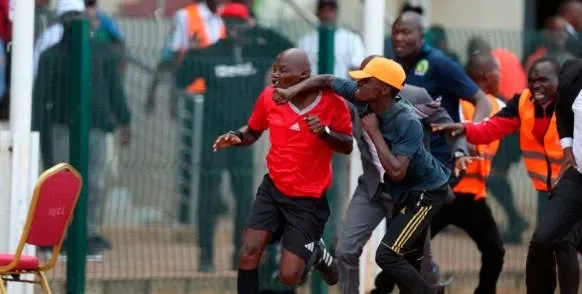
The decision provoked an angry reaction from Kariobangi Sharks players, who confronted the referee. The situation escalated when supporters invaded the pitch and the official was reportedly assaulted.
The match was abandoned after the referee was unable to continue.
The incident transformed what should have been a fiercely contested promotion battle into a serious test of football discipline and stadium security.

Whether the penalty was correctly awarded is a separate question. That can be examined through the referee's report, available footage, and the applicable rules.
But there is no legitimate sporting argument that turns disagreement with a penalty into a licence to assault the official who awards it.
A referee may make a mistake. Violence is not an acceptable method of correcting it.
WHY KARIOBANGI SHARKS COULD NOT SIMPLY WALK AWAY

The most important distinction in this controversy is between individual criminal responsibility and a football club's disciplinary responsibility.
Not every Kariobangi Sharks player should automatically be accused of assaulting the referee. Nor should every supporter be presumed to have participated in the violence.
Responsibility must be established against the individuals concerned through credible evidence.
However, football disciplinary proceedings also examine whether a club's players, officials, and supporters engaged in misconduct and whether the club bears responsibility under the applicable competition regulations.

In this case, the reported sequence of events was particularly serious: players confronted the referee following the penalty decision, supporters invaded the playing area, and the official was reportedly attacked.
The incident disrupted the match and made its continuation impossible.
The club consequently faced sporting consequences extending beyond the original disagreement over the penalty.
Under the reported application of Articles 3.3.2 and 3.3.3 of FKF's Rules and Regulations Governing Kenyan Football (2019), the abandoned match was forfeited by Kariobangi Sharks and awarded to Mombasa United by a 2–0 scoreline.
The principle behind such a decision is straightforward: a club should not expect to benefit from circumstances in which misconduct associated with its match prevents the opposition from completing the contest.
Otherwise, a dangerous precedent could emerge in which disorder becomes a means of preventing an unfavorable result from standing.
However, the precise disciplinary liability must be determined under the applicable rules and evidence, including any available appeal procedures.
The objective should be accountability, not arbitrary punishment.
FIFA RULES: ASSAULTING A REFEREE IS A SERIOUS OFFENCE
The global football governing body, FIFA, maintains a disciplinary framework that treats violence against match officials as a grave offense.
Article 14 of the 2023 FIFA Disciplinary Code provides for substantial suspensions for misconduct against referees and other match officials. Assaulting a match official attracts a minimum suspension of 15 matches or an appropriate period of time under that edition of the code.
The code also provides for disciplinary measures against teams and clubs in circumstances involving improper conduct.
These provisions demonstrate that football authorities do not regard an attack on a referee as merely an emotional outburst.
The referee is an essential participant in the game. Without an official empowered to apply the laws, manage players, and make decisions, a football match cannot function.
Attacking that official undermines the authority on which the competition depends.
The precise sanctions applicable to Kariobangi Sharks must, however, be determined under the relevant FKF regulations and disciplinary procedures. FIFA's international provisions should not automatically be treated as the direct legal basis for every domestic sanction.
Nevertheless, the international standard is clear: violence against match officials warrants serious disciplinary consequences.
What about the players who confronted the referee?
As a former footballer and coach, I understand the frustration that can follow a controversial decision in a high-stakes match.
Players invest time, energy, and ambition in a competition. A penalty awarded against them at a decisive moment can provoke intense emotions.
But professional discipline means controlling those emotions.
Players can ask for clarification within the laws of the game. Their captains can communicate with the referee through appropriate channels. Clubs can submit complaints supported by evidence where the regulations permit.
What players cannot do is intimidate, shove, strike, or threaten an official because they disagree with a decision.
The referee's authority does not depend on whether the players approve of the decision.
Where evidence establishes assault, threats, or other serious misconduct, the individuals concerned should face appropriate sanctions under the applicable regulations.
CAF RULES: FOOTBALL AUTHORITIES MUST PROTECT MATCH OFFICIALS
The Confederation of African Football (CAF) offers another important reference point.
CAF's disciplinary framework and Safety and Security Regulations address violence, unauthorised access to playing areas and failures to maintain order at football matches.
These standards reflect a basic requirement: football competitions must provide an environment in which referees, players, coaches, officials and spectators can participate without being exposed to avoidable danger.
CAF has previously sanctioned the FKF over safety and security breaches at continental competitions. Disciplinary decisions published in August 2025 included fines following incidents involving unauthorized access, a stampede, and an assault on CAF personnel and guests during continental football events.
The broader lesson is that responsibility for matchday disorder may extend beyond the individual who commits an assault.
Depending on the applicable regulations and the circumstances established, disciplinary responsibility may also arise from failures by clubs or associations to meet their safety and security obligations.
The Kariobangi Sharks incident therefore raises several questions.
Who was responsible for controlling access to the playing area?
Were the security arrangements adequate?
How did supporters gain access to the pitch?
What measures were taken to protect the referee when the confrontation began?
Did the club's officials take reasonable steps to prevent or contain the disorder?
These questions deserve answers from the relevant authorities.
CAF's rules should nevertheless be understood as a continental benchmark unless the applicable competition rules establish a direct basis for their use in a domestic proceeding.
THE REFEREE CANNOT BE THE PUNCHING BAG OF KENYAN FOOTBALL.
The incident exposes a wider problem in football culture: referees too often become convenient targets when a decision threatens a club's ambitions.
A penalty is awarded, a goal is disallowed, or a player is sent off, and suddenly the official is accused of conspiring against an entire team.
Some complaints may be legitimate. Refereeing errors do occur, and football authorities should maintain credible mechanisms for reviewing serious mistakes.
But there is a dangerous difference between demanding accountability and creating an atmosphere in which officials fear for their physical safety.
If referees must consider the possibility of being attacked whenever they make an unpopular decision, their independence is compromised.
The problem becomes particularly serious in matches where promotion, relegation, prize money and the future of a club are at stake.
The higher the stakes, the greater the need for discipline.
Having played football for Hakati Sports and coached teams including Lenana Warriors, I appreciate the emotional intensity of competitive football. A coach knows the sacrifices made by players and the disappointment that follows a potentially decisive decision.
But experience on the pitch and touchline also reinforces an essential lesson: discipline is most important when the decision goes against you.
It is easy to praise a referee when the whistle favours your team. The real test comes when a decision threatens your ambitions.
A club aspiring to compete at the highest level must demonstrate that it can manage disappointment without descending into violence.
SUPPORTERS MUST ALSO BE HELD ACCOUNTABLE
The pitch invasion cannot be dismissed as a minor sideshow to the confrontation between the players and the referee.
Supporters have every right to cheer their teams, criticise performances and express disappointment within lawful limits.
They do not have the right to invade the playing area and assault match officials.
A football ground is not a lawless territory where the crowd decides which rules deserve obedience.
Nor can a supporter justify violence by claiming that a referee has ruined a club's season.
The appropriate response to a questionable decision is a formal complaint, a review of available evidence or another remedy provided under the applicable regulations.
Once supporters enter the pitch and attack an official, the issue becomes one of safety, security and accountability.
Authorities should identify those involved through available video footage, eyewitness accounts and other credible evidence. Where individual criminal conduct is established, those responsible should face the consequences prescribed by law.
The same principle applies to club officials who may have participated in or encouraged misconduct. Their individual roles should be investigated rather than obscured by general accusations against an entire organisation.
At the same time, a club's collective disciplinary responsibility must be determined according to the rules governing the competition.
WHY THE FKF FORFEITURE DECISION MATTERS
The reported decision to award the abandoned match to Mombasa United carries significance beyond the immediate promotion contest.
According to reports, FKF's Leagues and Competitions Committee applied Articles 3.3.2 and 3.3.3 of the 2019 Rules and Regulations Governing Kenyan Football to declare the match forfeited by Kariobangi Sharks and award it to Mombasa United by a 2–0 scoreline.
The incident was also referred for further disciplinary consideration.
The decision sends a message that a club cannot automatically demand a replay simply because its players or supporters have been involved in disorder that brings a match to an end.
Such an outcome could otherwise create a dangerous incentive: a team dissatisfied with the direction of a match might benefit from circumstances that prevent the final result from being recorded.
Forfeiture can discourage that possibility where the applicable regulations provide for it and the evidence supports its use.
But consistency is essential.
FKF must apply its rules impartially, regardless of a club's profile, history or influence.
The same standards should govern misconduct in Nairobi, Mombasa, Kisumu, Nakuru or any other part of the country.
Punishment must be based on the regulations and evidence, not on the identity or popularity of the club.
That is how a federation establishes credibility.
WAS THE PENALTY CORRECT? THAT IS NOT A DEFENCE TO VIOLENCE
One question must not be lost in the outrage: was the penalty awarded to Mombasa United correct?
That question deserves an answer based on evidence.
A review of match footage, the referee's report and other relevant material could help establish what happened in the incident leading to the penalty.
If the referee made an error, the appropriate authorities should examine it through the procedures available under the competition rules.
But even a demonstrably incorrect penalty would not justify assault.
The laws of football do not grant players or supporters the power to punish referees physically whenever they believe an official has made a mistake.
The International Football Association Board's Laws of the Game provide for disciplinary action when players, substitutes, team officials or outside agents enter the field without authorisation. They also address situations in which unauthorised entry interferes with play or involves misconduct.
These provisions are intended to preserve order and allow matches to be conducted safely.
A referee's decision can be disputed without the referee being attacked.
Indeed, the more controversial a decision becomes, the more important it is for the authorities to distinguish between a legitimate complaint and conduct that threatens the integrity of the sport.
FKF MUST GO BEYOND AWARDING THE MATCH
Although the forfeiture decision determined the immediate sporting outcome, further disciplinary proceedings remain important.
The authorities should establish individual responsibility and consider any additional sanctions warranted by the evidence and applicable regulations.
That process should examine the conduct of players, technical personnel, other club officials and supporters whose actions can be established.
It should also examine stadium security arrangements and whether the responsible parties fulfilled their obligations.
Potential measures under the applicable rules may include individual suspensions, fines and other disciplinary sanctions. The precise measures should be determined after the relevant charges, evidence and responses have been considered.
FKF should also ensure that the referee receives appropriate support and that match officials can report threats or assaults without fear of retaliation.
There must be no double standard in which referees are expected to accept violence as an occupational hazard while clubs continue to demand professional officiating.
If Kenya wants a credible football league, it must protect the people who make that league possible.
That includes referees, assistant referees, players, coaches, security personnel and spectators.
A WARNING TO CLUBS ACROSS KENYA
The Kariobangi Sharks episode should prompt every club to review how its players and officials respond to controversial decisions.
Coaches and captains should be expected to calm tensions rather than inflame them.
Club management should make it clear that physical intimidation of match officials will not be tolerated.
Supporters should be reminded that the right to support a club does not include the right to endanger other people.
FKF must enforce the applicable rules consistently and transparently.
A strong disciplinary system will not eliminate every refereeing error. It will, however, help ensure that errors can be challenged without the game descending into violence.
THE FINAL VERDICT: PASSION IS NOT A LICENCE TO ASSAULT
Kariobangi Sharks may have had legitimate sporting grievances about the penalty awarded against them. That question can be examined separately.
But the reported assault on referee John Sulwe, the pitch invasion and the abandonment of the match created a far more serious problem than a disputed decision.
Football cannot function if players believe they can intimidate officials into changing their decisions or if supporters believe they can settle arguments by storming the pitch.
The forfeiture ruling against Kariobangi Sharks was therefore an important step in protecting the integrity of the competition, provided it was reached in accordance with the applicable regulations and evidence.
Further disciplinary proceedings should establish individual culpability and determine whether additional sanctions are justified.
The objective should not be revenge against a club. It should be accountability, deterrence and the protection of Kenyan football.
Mombasa United's promotion is one outcome of the ruling. The larger question is whether the incident will persuade clubs and supporters that violence has no place in the game.
As a former player, coach and football commissioner, I believe that the future of Kenyan football depends not only on the quality of its players but also on the discipline of its participants, the independence of its referees and the consistency of its governing institutions.
A referee's decision may cost a club a match. An attack on a referee can cost a club far more.
The laws of football exist because competition needs boundaries. Once those boundaries are replaced by fists, intimidation and pitch invasions, the game loses its meaning.
Kariobangi Sharks must answer for any misconduct established under the applicable rules, just as any other Kenyan club would have to.
The message to the entire football fraternity should be unmistakable: disagree with the referee if you must, challenge a decision through the proper channels, and demand accountability where evidence warrants it.
But keep your hands off the referee.
In football, the penalty spot is for taking penalties—not for starting a war against the man who awards them.
No comments yet. Be the first to share your thoughts.