
In the dangerous streets of Nairobi during the 1990s, a police officer could not always fight crime in uniform.
Sometimes, survival demanded the opposite.
An officer had to disappear into the crowd, bury his identity beneath an assumed name, cultivate the appearance of an ordinary citizen, and venture into places where a single mistake could mean death.

There were no reassuring police insignia to command respect, no uniform to announce authority, and no guarantee that colleagues would arrive in time if an operation went wrong.
There was only the mission, the intelligence gathered, and the terrifying possibility that the people being hunted might discover who was hunting them.
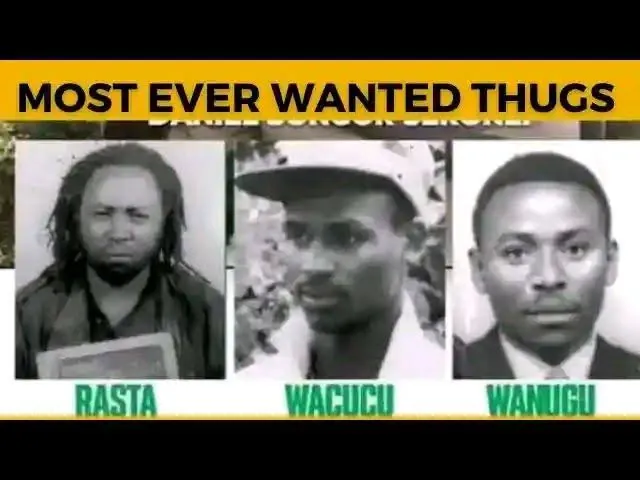
It was in this shadowy world of covert policing that the reported exploits of Daniel Songor Seronei and policewoman Amina Chute became associated with the pursuit of three notorious gangsters: Rasta, Wacucu, and Wanugu.
Working in connection with the Alpha Romeo unit, the two officers reportedly used undercover identities, surveillance, and intelligence gathering to penetrate criminal networks.
Their story offers a dramatic window into an era when violent crime tested the capacity of Kenyan law enforcement—and when the pursuit of suspected criminals could place investigators themselves in extraordinary danger.
But beyond the personalities, aliases, and accounts of dangerous encounters lies a larger question: what does it take to confront a criminal underworld, and what happens to the people who risk everything to penetrate it?
ENTERING THE LION’S DEN
For a conventional police officer, the uniform is a declaration of authority.

For an undercover operative, it can be a liability.
The assignment demands a different kind of courage: the ability to remain composed while surrounded by people who might become hostile if they discover the truth.
An undercover officer must observe without appearing to investigate, ask questions without arousing suspicion, and gather information without exposing the operation.
Every conversation carries potential intelligence. Every unfamiliar face presents a possible threat. Every careless word can destroy weeks of painstaking work.

According to accounts of their operations, Seronei and Chute entered this uncertain world to help track suspected criminals whose names had become associated with serious violence.
Seronei was reportedly linked to the street identity Alpha Romeo, while Chute was said to have participated in surveillance and intelligence gathering.
The reported strategy was built around proximity. To understand a criminal network, investigators needed information about its movements, associations, and possible hideouts.
That meant venturing closer to the people they were investigating.

Yet proximity also created danger.
An undercover officer could be surrounded by potential suspects without knowing who might recognize him, who might betray him, or who might already suspect that something was wrong.
In such circumstances, the difference between a successful operation and a fatal mistake could be painfully small.
The precise operational structure of the Alpha Romeo unit, the officers' individual assignments, and the details of their reported encounters require corroboration through interviews and historical police records.
Nevertheless, the account captures the central dilemma of undercover policing: investigators must enter dangerous environments without allowing those environments to discover their purpose.
THE NAMES THAT EVOKED FEAR
Rasta. Wacucu. Wanugu.
The three names occupy a place in accounts of Kenya's criminal history associated with violent crime and the public anxiety surrounding armed criminal gangs.
For residents confronted by reports of robberies and other violent incidents, the fear was immediate and personal.
A criminal investigation, meanwhile, required something more than public alarm. Police needed intelligence capable of identifying suspects, tracing their movements, and building a basis for intervention.
This was the world in which Seronei and Chute were reportedly involved.
Their alleged pursuit of the three men illustrates the importance of intelligence-led policing: the painstaking process of gathering information, identifying patterns, and connecting people, places, and incidents before an operation can be mounted.
Unlike the dramatic image of police officers bursting through a door, intelligence work can be slow, repetitive, and inconspicuous.
It may involve hours of observation for a single useful lead.
It may require investigators to abandon an apparently promising trail because the evidence does not support it.
And it may demand patience when the public expects immediate action.
For an undercover operative, the challenge is compounded by the need to maintain a credible identity while remaining alert to possible danger.
The reported operations involving Seronei and Chute have been associated with the eventual deaths of the three gangsters. However, the circumstances of those deaths, the precise roles played by individual officers, and the sequence of events must be established through independent records before a definitive historical account can be published.
That distinction is essential.
A compelling police story should not confuse an established fact with a recollection, an allegation, or a legend that has grown over time.
The public deserves to know not merely who was feared, but what happened, how it happened, and what evidence supports the account.
WHEN THE HUNTERS BECAME THE HUNTED
The danger associated with covert policing does not necessarily end when an operation is completed.
An officer whose identity becomes known to suspected criminals may remain vulnerable long after leaving the field.
The risks can become even more complicated when an officer believes that a threat originates not only from criminal suspects but also from people within the police service.
Seronei reportedly survived a separate ambush that he attributed to rogue police officers and gunmen.
The allegation introduces a disturbing dimension to his story.
If an officer tasked with enforcing the law believes that serving officers or people connected to law enforcement may be involved in an attack against him, where can he turn for protection?
Who investigates the investigators?
And what happens when an officer's personal security depends on an institution in which he believes there may be individuals threatening him?
These are serious questions, but the reported ambush must not be treated as proof of police complicity without independent evidence.
Its circumstances, the identities of the alleged attackers, and any subsequent investigations would need to be established through testimony, police records, or court documents.
Even so, the account points to a fundamental principle of democratic policing: officers must be protected from criminal retaliation, while allegations of misconduct involving members of the service must be investigated independently and impartially.
Without credible accountability mechanisms, public confidence can be damaged and officers who report wrongdoing may be left vulnerable.
The law cannot command public trust merely by demanding obedience. It must demonstrate that those who enforce it are also subject to its requirements.
AMINA CHUTE: THE PERSONAL COST OF COVERT POLICING
The reported experiences of Amina Chute add another dimension to the story.
Chute was said to have participated in the intelligence operations alongside Seronei. Accounts also suggest that concerns about her safety preceded her departure for the United Kingdom.
The circumstances surrounding that departure, including the nature of the alleged threats and their connection to her police work, require further verification.
But the broader issue deserves attention.
Undercover policing places unusual demands on those who undertake it. Maintaining a concealed identity can complicate relationships, restrict what an officer can disclose, and create a persistent separation between professional responsibilities and ordinary life.
The burden may extend beyond the operation itself.
An officer may have to remain guarded about past assignments, avoid discussing sensitive experiences, and consider whether people encountered during an investigation might recognize or locate them later.
For women working in such environments, a full historical account must also examine the particular operational challenges they faced without assuming that gender alone determines their experiences.
Chute's reported role raises important questions about the recognition of female officers in criminal intelligence, the protection afforded to undercover personnel, and the institutional support available when assignments end.
What training did officers receive before deployment? Who assessed the risks? What arrangements were made to protect their identities? And what assistance was available to personnel who believed their lives remained in danger?
These questions cannot be answered through dramatic recollections alone. They require evidence from the officers themselves, their former colleagues, and the relevant institutions.
Their answers could help move the story beyond individual heroism to a fuller examination of how Kenya's police service managed the human consequences of covert operations.
NAIROBI’S CRIME BATTLE: THE BIGGER PICTURE
The story of Seronei and Chute belongs to a wider history of Kenya's struggle against violent crime.
Nairobi's security challenges have changed over the decades. Criminal investigations have had to respond to changing patterns of robbery, organized criminal activity, fraud, and other offenses, as well as new methods of communication and surveillance.
The demands on police investigators have changed accordingly.
But the central requirements remain familiar: reliable intelligence, professional investigation, competent prosecution, effective cooperation among agencies, and public confidence in law enforcement.
Undercover operations can help investigators gather information that may be difficult to obtain through conventional methods. They are not, however, a substitute for evidence-based investigations, lawful procedures and judicial scrutiny.
Nor can policing alone eliminate the conditions that allow criminal networks to flourish.
Economic exclusion, unemployment, the circulation of illegal firearms, weak investigative capacity and failures of accountability may all complicate efforts to prevent and respond to crime. The significance of each factor must be assessed using reliable evidence rather than assumed in any individual case.
A sustainable response requires both effective enforcement and attention to the wider conditions that influence criminal activity.
It also requires a distinction between arresting suspects and securing lawful convictions. Investigators must collect admissible evidence, prosecutors must assess the strength of cases, and courts must determine guilt according to the law.
The dramatic pursuit of a suspected criminal may attract public attention, but the integrity of the justice system depends on what can be established through evidence.
That principle is particularly important when examining historical police operations whose details may have been preserved through personal recollection rather than accessible official records.
THE QUESTION OF POLICE ACCOUNTABILITY
The reported experiences of Seronei and Chute invite a closer examination of the relationship between operational courage and institutional responsibility.
Undercover officers accept risks in the course of their duties. That does not mean they should be expected to confront those risks without adequate preparation, supervision or protection.
A professional police service must have clear procedures for authorising covert assignments, protecting confidential identities, managing operational intelligence and assessing threats to personnel.
It must also provide credible channels through which officers can report suspected misconduct without fear of retaliation.
Where allegations involve serving officers, independent investigation is particularly important. Neither professional loyalty nor public suspicion should replace evidence.
These safeguards protect more than individual officers. They also protect investigations from compromise, preserve the integrity of evidence and strengthen the legitimacy of police action.
Kenya's experience with crime therefore raises a question beyond the identities of particular suspects or the outcome of a single operation: how can the country ensure that the people entrusted with public security operate effectively while remaining accountable to the law?
The answer lies not in romanticising covert policing, but in understanding its methods, limitations and responsibilities.
A REUNION WITH THE PAST
Years after their reported operations, a reunion between the former colleagues was said to have revived memories of their experiences.
Such encounters can be important opportunities to preserve the history of police work that may have unfolded largely outside public view.
They can also help reconstruct events that official records do not fully capture.
But recollection must be handled carefully. Memories can differ, timelines can become blurred and accounts may be influenced by information learned after the events.
A rigorous investigation would seek separate interviews with Seronei and Chute, establish a chronology of their assignments and compare their accounts with those of former colleagues and other witnesses.
Contemporary newspaper reports, police documentation and relevant court records could help establish the circumstances surrounding the three gangsters, the reported ambush and Chute's departure.
Where evidence is unavailable, uncertainty should be acknowledged rather than filled with speculation.
The objective should not be to diminish the experiences of the officers. It should be to document them accurately enough that their history can withstand scrutiny.
THE LEGACY BEYOND THE LEGEND
The reported story of Daniel Songor Seronei and Amina Chute offers a glimpse into the difficult world of undercover policing, where information can be as valuable as force and where an officer's greatest protection may be the ability to remain unrecognised.
Their association with the pursuit of Rasta, Wacucu and Wanugu has helped preserve a narrative of covert operations during a turbulent period in Kenya's criminal history.
Yet their experiences also point to issues that deserve attention beyond the legend: the safety of investigators, the importance of reliable intelligence, the need for independent oversight and the responsibility of institutions to protect personnel who undertake dangerous assignments.
The most important question is not simply how undercover officers track suspected gangsters.
It is whether the system gives them the training, resources, protection and accountability mechanisms needed to perform their duties lawfully and return safely to ordinary life.
For a country confronting persistent security challenges, that question remains relevant.
Crime cannot be defeated by fear alone, nor can public confidence be sustained by stories of daring operations without a commitment to evidence and accountability.
The ultimate measure of a successful criminal justice system is not the reputation of the officers who operate in its shadows or the notoriety of the suspects they pursue.
It is whether the law is enforced effectively, whether the innocent are protected, whether wrongdoing is investigated impartially and whether justice survives the pressure of the hunt.
For Seronei and Chute, the reported pursuit of three notorious gangsters is only one part of the story.
The deeper story concerns the price of entering the criminal underworld in the service of the law—and the responsibility of the state to ensure that those who undertake that dangerous work are not forgotten when the operation ends.
No comments yet. Be the first to share your thoughts.